Crew
of One

PRODUCTION
TALES
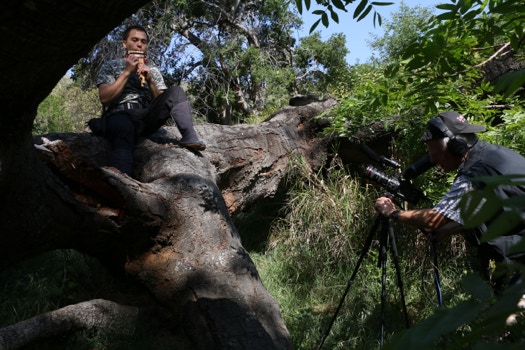
I was writer, director, producer, DP, and location sound guy for “Alien Prophecy.” I did not have a crew. To make up for it, I was editor, VFX artist, composer, etc. on post. This was due to various Darwinian factors—LA street-level production is somewhat mercenary, with people checking in and out of projects. That doesn’t work for me. Plus, there are many advantages to drawing minimum attention to the production process and focusing on the quality of the content. It was just more efficient to work independently.
I’m not done until I’ve absolutely pushed my limits and redlined my abilities. There wasn’t a single part of working on
“Alien Prophecy” where I didn’t do my best work.
The Heron
Survives
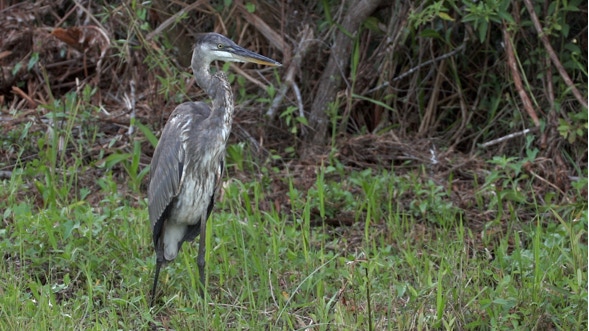
One of the themes explored in “Alien Prophecy” is the effect of burning fossil fuels on nature. To illustrate this I filmed wildlife in various locations, one of which was the Shark Valley area of Everglades National Park in Florida.
I followed a path near a canal, set-up the camera, and began filming a nearby great blue heron. As the minutes passed I could see how comfortable the heron had become with me. I moved the tripod to within about a yard and filmed close-ups. The bird was completely calm. After about 10 minutes or so I had all the footage I needed and moved the tripod away to capture the sunset.
Suddenly, I heard a swooshing sound.
The Great Blue Heron, four feet tall and seven pounds dripping wet, had been attacked by an alligator.
The sound penetrated to the depths of my subconscious.
I looked over. The heron had escaped and stood in a grassy area. The alligator was on the edge of the canal, jaws open, staring at the heron. The heron stared back, slowly moving its beak open and closed, as if taunting the alligator. I was about seven yards away from the alligator with nothing but open space between us. Within a minute or so the alligator slipped back into the swamp.
Journey into
Pre-History
The Anhinga trail, the Everglades. Around 5:45pm. I walked along a raised wooden walkway with railings, just a few feet above the swamp. I looked to my left. Suddenly I noticed an alligator right next to me, just a few yards below the edge of the walkway. “Whoa!” I exclaimed. The alligator, just as surprised, quickly left the area.
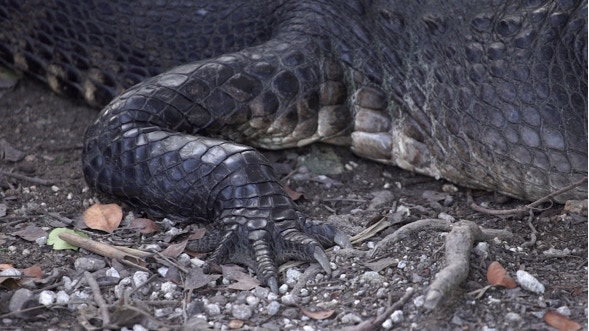
I then continued to an area of the walkway that dead-ended into a pond. I set-up the camera. I was literally surrounded by 7-8 alligators—just a few yards away in the swamp below. The scene was completely surreal—like I had just stepped into a time when dinosaurs ruled the planet. Each alligator was about 8 feet long and can weigh up to 800 pounds. Their bite force has been measured at 2,125 pounds per square inch.
I could feel my neurons being rewired.
I approached one particular alligator and set-up the camera. I looked at him. He looked at me. It was hallucinatory. I set up the camera and took extreme close-up shots—of the alligator’s legs, texture of the skin, a shot of just an eye. I was in the presence of an ancient, primordial force of nature.
This experience became a scene in "Alien Prophecy,” where Esmeralda, the Colombian/Australian hit woman, has a face-to-face encounter with an alligator—“Nature’s perfect assassin.”
Poison
Dart Frogs
and the
Naso Indians
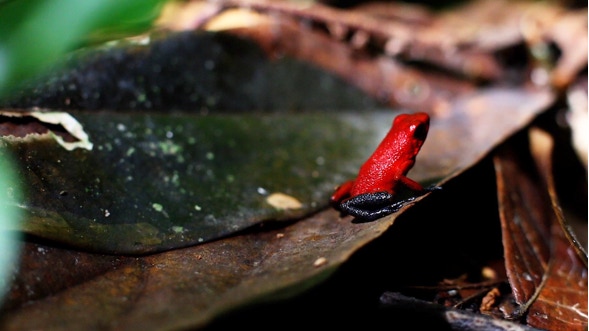
I traveled to the Bocas del Toro region of northern Panama—near the border of Panama and Costa Rica—to film wildlife in support of the nature themes of “Alien Prophecy.” I was fortunate to have the opportunity to stay with a family of Naso Indians on their farm and went hiking with a guide named Azael Guttierez through the rainforest behind their property. We came across a bright red poison dart frog, venom glistening on its skin.
The frog was exactly what I wanted to film.
I kneeled on the rainforest floor and lowered the camera, filming with a 50mm prime lens. It was very hard to frame a shot. Since the frog was so small (less than 1/2 an inch long) I had to get the camera in close and there was very little depth-of-field, making pulling focus very difficult. The frog jumped around uncontrollably.
In order to help get the shot Azael picked up the poison frog with his bare hands. The warmth of his skin caused the frog to become “manso,” or tame. Somehow Azael—perhaps from growing up in the rainforest—knew what to do with the poison on his skin and felt no effect. Then we came across an emerald green frog about an inch-and-a-half long. I was able to film that frog in its natural state without any assistance.
In April 2017 I went to the National Association of Broadcasters show in Las Vegas and met a cameraman from National Geographic. He said that the major documentary companies put the poison frogs in an artificial enclosure and film them there. Then they edit the footage to make it look like they’re in the wild. In April 2018 at the same event I met a major German wildlife photographer who had filmed frogs in Africa. He said it was impossible to film frogs with a 50mm prime lens.
High Winds
in the
Barstow
Desert
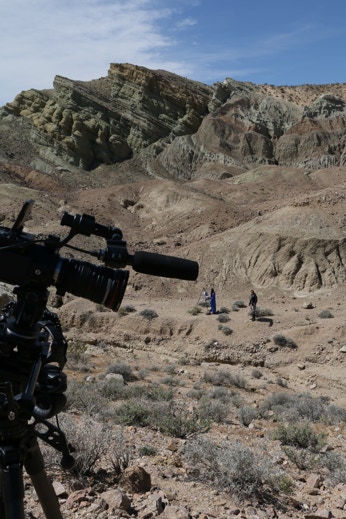
The Middle Eastern scene in “Alien Prophecy” was filmed in Barstow, California. When we arrived at our location actress Sarah Attrill, who plays “Esmeralda,” said it reminded her of the ancient archeological site of Petra in Jordan (which she has visited). Temples appeared to be buried under the natural earth hills.
That day there was a very strong wind—gusting to around 40-50 mph. I stood on a large boulder that I wanted Sarah to stand on. At 6’ 1” and 185 pounds I felt myself getting pushed back. I was concerned that Sarah could literally get blown off. So I chose another area that was more sheltered. I set-up the camera on the tripod. The wind knocked it over. I set it up again—the wind knocked it over again. I had never filmed under such conditions. The easel we were using for the scene also kept getting blown over. Brent and Sarah fortified the easel with rocks around the legs and for a while it was quite stable. Then the wind got stronger and flexed the wooden easel legs until they snapped. We had to do an emergency repair job. Fortunately, we were able to get all the footage we needed. In the background of some shots were geology students from the University of California, Santa Barbara—they served as spontaneous insurgents.
My father went to Syria before the current conflict. I composited his photos of the Roman Aphamia Antioch Gate and the fifth-century church the Basilica of San Simeon (damaged by a Russian airstrike in 2016) in some visual effects sequences. Our collaboration made me closer to the story. I lost my father to cancer in 2010; many in Syria have lost their fathers to war.